

 By
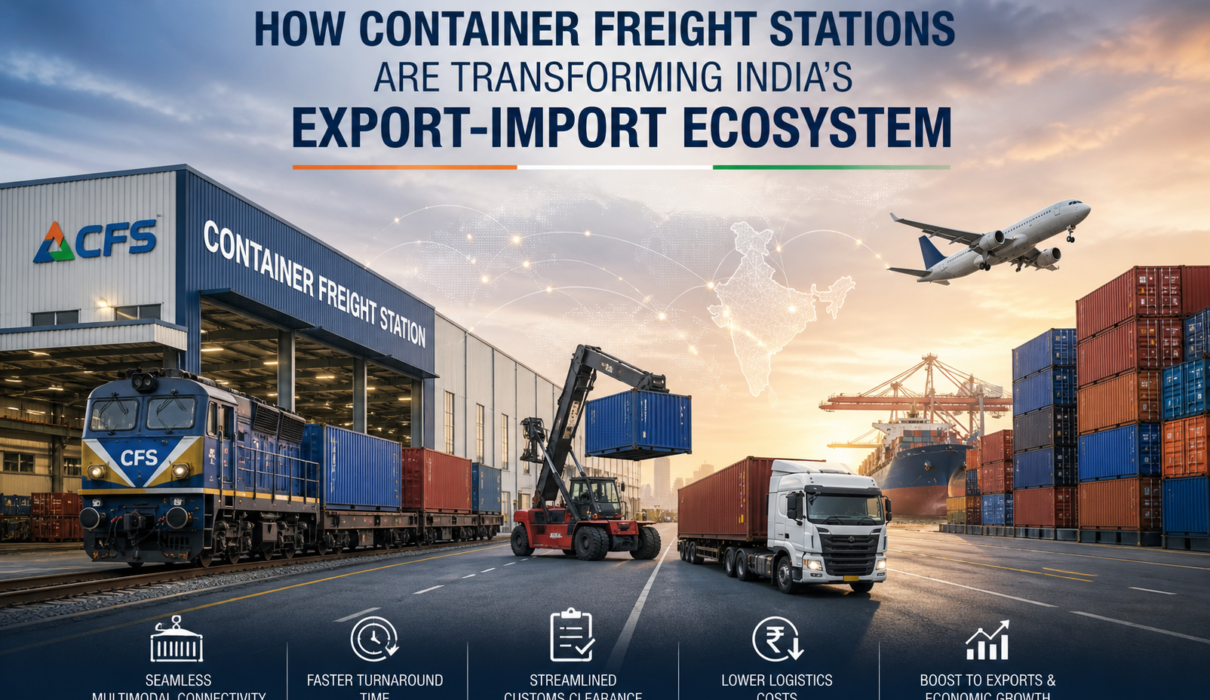
By India’s trade industry is evolving rapidly, driven by increasing global demand, expanding manufacturing sectors, and growing international connectivity. At the centre of this transformation lies an often-overlooked yet highly essential logistics component — the Container Freight Station (CFS). These facilities have become critical in streamlining cargo movement, reducing congestion at ports, and improving the overall efficiency of the export-import ecosystem.
As India continues to strengthen its position in global trade, container freight stations are playing a major role in making logistics faster, smarter, and more reliable.
Understanding the Role of Container Freight Stations
A Container Freight Station is a specialised logistics hub located near ports or inland areas where import and export containers are consolidated, deconsolidated, stored, and cleared by customs. Instead of handling all cargo activities directly at crowded seaports, many operations are shifted to CFS facilities to improve efficiency.
These stations act as an important link between shipping lines, transporters, customs authorities, exporters, and importers. From cargo handling and documentation to warehousing and transportation coordination, container freight stations simplify complex logistics processes.
Reducing Port Congestion and Delays
One of the biggest challenges faced by major Indian ports is congestion. With increasing cargo volumes arriving every day, ports often struggle with space limitations and operational delays. Container freight stations help ease this burden by moving containers away from the port area for processing and storage.
This decentralised approach significantly reduces waiting times for vessels and transport vehicles. As a result, cargo movement becomes smoother, turnaround times improve, and businesses experience fewer delays in shipment deliveries.
For exporters and importers, this efficiency directly impacts operational costs and customer satisfaction.
Supporting Faster Customs Clearance
Customs procedures are a crucial part of international trade, but they can often become time-consuming without proper infrastructure. Modern container freight stations are equipped with dedicated customs examination areas, digital documentation systems, and streamlined inspection processes.
By enabling faster customs clearance, CFS facilities help businesses avoid unnecessary demurrage charges and shipment hold-ups. Many facilities now use technology-driven systems that allow real-time cargo tracking, digital approvals, and automated documentation handling, making the process far more transparent and efficient.
Strengthening India’s Logistics Infrastructure
India’s logistics industry is undergoing a significant transformation with investments in highways, rail networks, ports, and multimodal transport systems. Container freight stations complement this growth by acting as integrated logistics hubs that connect transportation networks seamlessly.
Cargo arriving at ports can quickly move to nearby CFS facilities and then be transported through road or rail transportation services to different parts of the country. This integration helps businesses maintain supply chain continuity while improving delivery timelines.
As industries such as manufacturing, retail, pharmaceuticals, and e-commerce continue to grow, the role of container freight stations becomes even more important in supporting large-scale cargo operations.
Enhancing Warehousing and Cargo Management
Modern container freight stations are no longer limited to basic storage operations. Today’s facilities often include advanced warehousing solutions, cargo handling equipment, inventory management systems, and security infrastructure.
These upgraded warehousing capabilities help businesses manage goods more effectively before distribution or export. Temperature-sensitive cargo, high-value products, and bulk shipments can now be stored safely under controlled conditions.
Efficient warehousing also reduces the risk of cargo damage, mismanagement, and operational bottlenecks, contributing to smoother supply chain operations.
Encouraging Global Trade Growth
India’s participation in global trade has increased significantly over the years, and efficient logistics infrastructure is essential to maintaining this momentum. Container freight stations support international trade by improving cargo handling efficiency, reducing transit delays, and ensuring better coordination between stakeholders.
Global container terminals and CFS facilities together create a strong logistics ecosystem that supports importers, exporters, and shipping companies alike. Their combined role helps Indian businesses remain competitive in the international market.
Final Perspective
Global container terminals have become far more than storage and cargo handling centres. They are now strategic logistics partners driving efficiency across India’s export-import ecosystem. By reducing port congestion, improving customs clearance, supporting transportation networks, and enhancing warehousing operations, these facilities are reshaping how cargo moves across the country.
As India continues to expand its global trade footprint, the importance of efficient and technology-driven container freight stations will only continue to grow. Businesses that rely on seamless logistics operations are increasingly recognising the value these facilities bring to modern supply chain management.